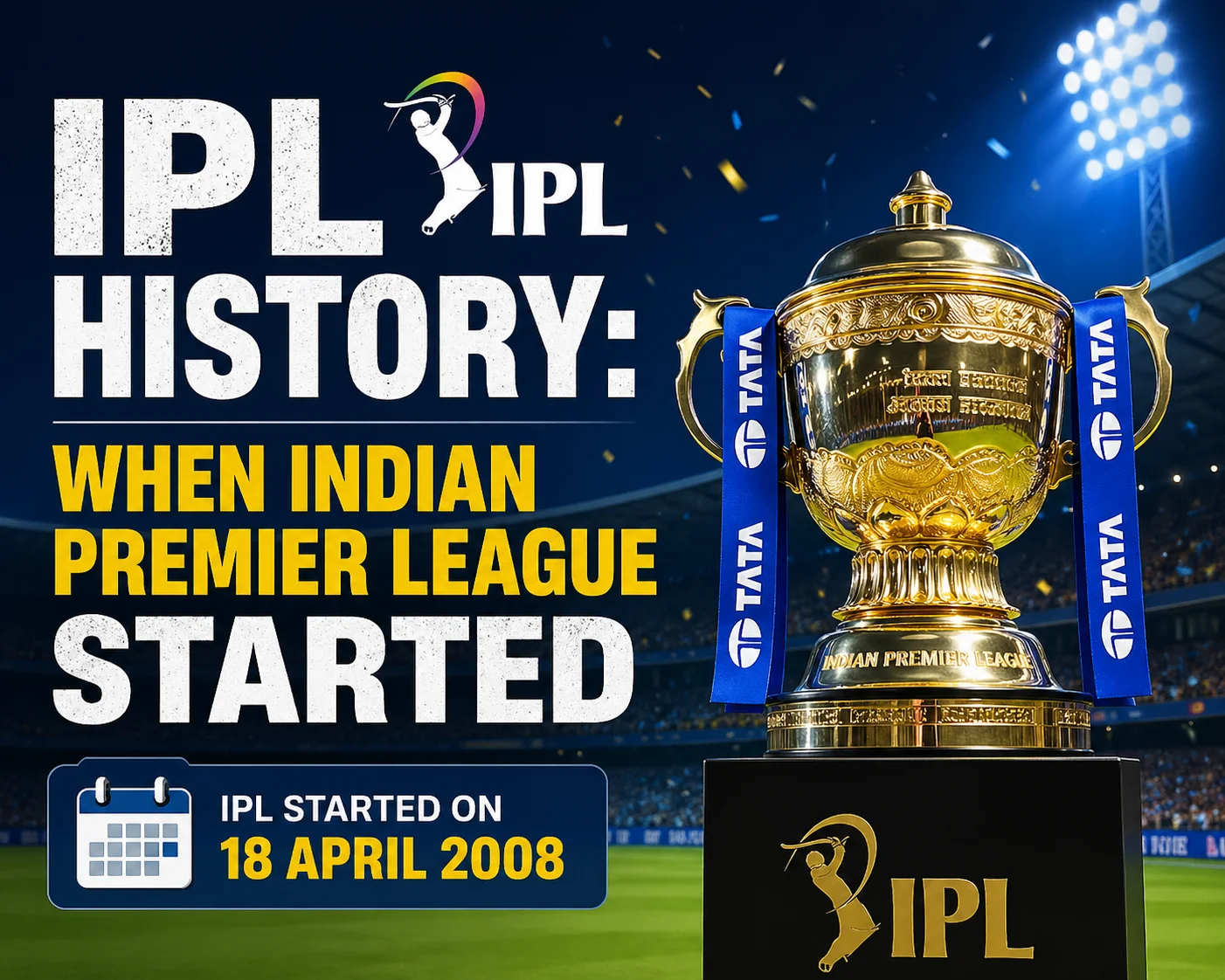
IPL History: When Indian Premier League Started
Introduction
The Indian Premier League (IPL) is the world’s most popular and valuable franchise-based Twenty20 cricket league, organized by the Board of Control for Cricket in India (BCCI).
Since its launch in 2008, IPL has transformed cricket globally by combining:
- professional franchise competition
- international player participation
- entertainment-driven presentation
- modern broadcasting innovation
In this complete guide, you will learn:
- When IPL started
- Who founded IPL
- Why IPL was created
- Details of the first IPL season
- How IPL became the biggest T20 league in the world
- The impact of IPL on international cricket
This article explains the true timeline and origin story of IPL from idea to global dominance.
When Did Indian Premier League Start?
The Indian Premier League officially started on 18 April 2008.
The first IPL match was played at:
M. Chinnaswamy Stadium, Bangalore
Match:
Royal Challengers Bangalore vs Kolkata Knight Riders
During this historic opening match:
Brendon McCullum scored 158 runs (73 balls)*
This iconic innings helped launch IPL with global attention and remains one of the most memorable performances in T20 cricket history.
Who Started the Indian Premier League?
IPL was created by the Board of Control for Cricket in India (BCCI).
The league was officially launched under the leadership of:
Lalit Modi (Former BCCI Vice President and IPL Founder-Chairman)
He played a major role in:
- Designing the franchise structure
- Organizing the first player auction (2008)
- Securing team owners
- Negotiating broadcasting deals
- Introducing the city-based team concept
IPL quickly became cricket’s most successful commercial league.
Why Was IPL Created?
IPL was launched with several important objectives.
1. Modernizing Cricket Entertainment
Before IPL, cricket leagues were mostly traditional domestic tournaments.
IPL introduced:
- Franchise ownership model
- International player drafts
- Player auctions
- Night matches
- Entertainment-driven presentation
This changed cricket forever.
2. Competing With Emerging T20 Leagues
In 2007, the Indian Cricket League (ICL) created competition inside India’s cricket ecosystem.
BCCI responded by launching IPL as its official professional T20 league.
IPL quickly replaced ICL as the dominant franchise competition in India.
3. Creating a Global Cricket Business Model
IPL allowed:
- International players to compete together
- Indian domestic players to gain exposure
- Franchises to invest in cricket
- Broadcasters to reach global audiences
Today, IPL is the most valuable cricket league in the world.
Details of the First IPL Season (2008)
The first IPL season took place during April–June 2008.
Number of Teams
8 franchises participated.
Original IPL Teams
- Mumbai Indians
- Chennai Super Kings
- Kolkata Knight Riders
- Royal Challengers Bangalore
- Delhi Daredevils (now Delhi Capitals)
- Rajasthan Royals
- Kings XI Punjab (now Punjab Kings)
- Deccan Chargers (later replaced by Sunrisers Hyderabad)
Who Won the First IPL Season?
The first IPL champion (2008) was:
Rajasthan Royals
Captain:
Shane Warne
Rajasthan Royals defeated:
Chennai Super Kings
Final venue:
DY Patil Stadium, Navi Mumbai
This victory remains one of the most memorable moments in IPL history.
How IPL Changed World Cricket
IPL transformed cricket in several major ways.
Global Player Participation
For the first time:
Players from multiple countries regularly played together in franchise teams.
This increased:
- International exposure
- Player income
- Competitive standards
Growth of Young Indian Talent
IPL helped develop players such as:
- Jasprit Bumrah
- Hardik Pandya
- Ravindra Jadeja
- Ruturaj Gaikwad
Many later became international stars.
Revolutionizing Cricket Broadcasting
IPL introduced:
- Strategic timeouts
- Player microphones
- Advanced analytics
- Ultra-HD production
- Global streaming reach
These innovations influenced cricket broadcasting worldwide.
IPL Expansion and Growth Over the Years
IPL continued evolving after its launch.
Major milestones include:
- 2008 — League launched with 8 teams
- 2011 — Expansion to 10 teams
- 2013 — Deccan Chargers replaced by Sunrisers Hyderabad
- 2022 — Expansion to 10 teams again with:
- Gujarat Titans
- Lucknow Super Giants
Today IPL remains the world’s richest cricket league.
Why IPL Became the Biggest Cricket League in the World
Several factors contributed to IPL’s global success.
Strong Financial Structure
IPL generates billions in media-rights revenue.
Star Player Participation
Top international cricketers participate every season.
Massive Fan Base
IPL attracts audiences across:
- India
- Asia
- Australia
- England
- Middle East
- North America
High-Quality Competition
IPL matches consistently feature elite-level T20 cricket.
Impact of IPL on Global Cricket
IPL influenced cricket globally by:
- Inspiring leagues like PSL, BBL, CPL, SA20
- Improving player fitness standards
- Increasing cricket salaries worldwide
- Creating franchise-based cricket ecosystems
Today IPL is considered the benchmark for modern T20 leagues.
Conclusion
The Indian Premier League started in 2008 as a visionary initiative by the BCCI and Lalit Modi, transforming cricket into a global franchise sport.
From its historic opening match in Bangalore to becoming the world’s biggest cricket league, IPL continues to shape the future of international cricket every year.
👉 For more verified cricket history, match previews, team insights, and record breakdowns, stay connected with GNT Sports.