FIFA World Cup 2026 Prize Money: How Much Will the Winners Earn?
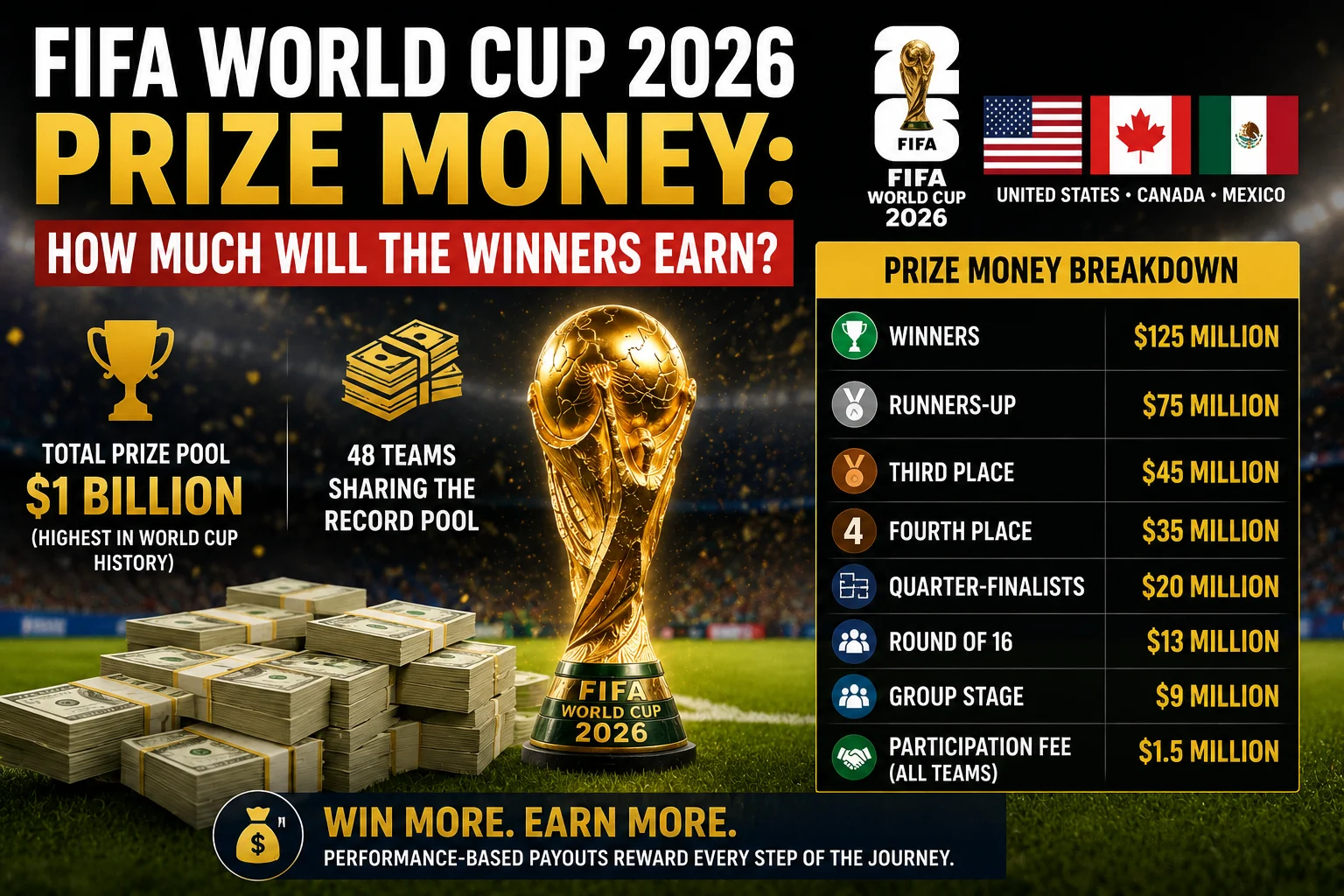
The FIFA World Cup 2026 is the most lucrative football tournament in history. The total prize fund has been confirmed at $871 million — nearly double what was distributed at Qatar 2022. The team that lifts the trophy at MetLife Stadium on July 19 will take home $50 million. The team that goes out in the group stage will still walk away with $9 million.
This is the complete, verified breakdown of the 2026 World Cup prize money — what every team earns per round, how the fund compares to previous tournaments, what the numbers mean for smaller nations, and what actually happens to the money once FIFA hands it over.
The Headline Number: $871 Million
FIFA's original announcement in December 2025 set the total prize fund at $727 million — already a record. But following negotiations with national associations over the rising costs of participating in a tournament spread across three countries and 16 venues, FIFA increased the total in April 2026.
The final confirmed figure is $871 million — a 98% increase on Qatar 2022's $440 million fund.
For context, this is what the prize money growth looks like across recent tournaments:
| Year | Host | Total Fund | Winners' Share |
|---|---|---|---|
| 2014 | Brazil | $576 million | $35 million |
| 2018 | Russia | $400 million | $38 million |
| 2022 | Qatar | $440 million | $42 million |
| 2026 | USA/Canada/Mexico | $871 million | $50 million |
The $871 million figure includes $120 million in preparation fees paid upfront to all 48 teams before the tournament begins. Every qualified nation receives $2.5 million just for showing up — before a single ball has been kicked.
The Complete Prize Money Breakdown — Per Round
This is the official round-by-round breakdown, confirmed by FIFA and reported by ESPN and beIN Sports.
| Round | Teams | Prize per Team |
|---|---|---|
| Group stage elimination | 16 teams | $9 million |
| Round of 32 elimination | 16 teams | $11 million |
| Round of 16 elimination | 8 teams | $15 million |
| Quarter-final elimination | 4 teams | $19 million |
| 4th place | 1 team | $27 million |
| 3rd place | 1 team | $29 million |
| Runner-up | 1 team | $33 million |
| Champions | 1 team | $50 million |
Every figure above is before the $2.5 million preparation fee, which is paid separately to every team regardless of how far they advance.
What the Winners Actually Take Home
The 2026 World Cup champions will receive $50 million in prize money — plus the $2.5 million preparation fee paid before the tournament. That brings the total FIFA payment to the winning federation to approximately $52.5 million.
To put that in perspective:
- Italy received $2.2 million for winning the 1982 World Cup — the first year FIFA publicly disclosed prize money.
- Spain received $30 million for winning in 2010.
- France received $38 million for winning in 2018.
- Argentina received $42 million for winning in Qatar 2022.
- The 2026 champions will receive $50 million — a 19% increase on 2022.
The $50 million represents a 23-fold increase over the 44 years since Italy lifted the trophy in Spain in 1982. Every single World Cup since 1982 has paid more to the winners than the one before it, without exception.
Who Gets the Money — The Federation, Not the Players
This is the most important point that gets misunderstood every four years: FIFA does not pay prize money to players. The money goes to the national football federation of each competing country.
What happens to it after that is entirely up to the federation. Different countries handle it differently:
Some federations divide a large share of the prize money directly among the playing squad as bonuses. Others use the funds to cover tournament operating costs — travel, training camps, medical staff, equipment — before any player bonuses are calculated. Some federations reinvest a portion into the domestic league, youth development, women's football or grassroots infrastructure.
For major footballing nations — France, England, Germany, Spain — the $50 million is significant but not transformative. Their football infrastructure is funded by domestic broadcast deals, club revenues and commercial partnerships far exceeding any World Cup payout.
For smaller nations — Cape Verde, Curaçao, Jordan, Uzbekistan, all making their first World Cup appearances in 2026 — the guaranteed $9 million minimum is genuinely life-changing. Cape Verde, for instance, is an island nation of 600,000 people. A $9 million injection into their national football association could fund a decade of youth development.
Club Compensation — The Hidden Number
Beyond the prize money paid to national federations, FIFA also compensates the clubs that release their players for the tournament.
For the 2026 World Cup, FIFA has confirmed $355 million will be distributed to clubs whose players take part. This figure is separate from the $871 million team prize fund and reflects the acknowledgment that club football — through wages and player development — produces the quality that makes the World Cup possible.
A club like Manchester City, which might release 8 to 10 players for the tournament, will receive compensation for each week those players are unavailable. This system has been a source of ongoing tension between FIFA and European clubs, but the increased 2026 payments represent the most substantive compensation package in World Cup history.
Prize Money History — How We Got Here
FIFA first disclosed World Cup prize money publicly in 1982. The growth since then reflects the explosion of global football as a commercial property.
| Year | Host | Winners' Prize |
|---|---|---|
| 1982 | Spain | $2.2 million |
| 1986 | Mexico | $2.8 million |
| 1990 | Italy | $3.5 million |
| 1994 | USA | $4 million |
| 1998 | France | $6 million |
| 2002 | Japan/South Korea | $8 million |
| 2006 | Germany | $20 million |
| 2010 | South Africa | $30 million |
| 2014 | Brazil | $35 million |
| 2018 | Russia | $38 million |
| 2022 | Qatar | $42 million |
| 2026 | USA/Canada/Mexico | $50 million |
The jump from $6 million in 1998 to $20 million in 2006 reflects the transformation of football into a global media product, driven by satellite television and the emergence of massive broadcast rights deals. The 2026 figure reflects FIFA's projected revenue of over $11 billion for the 2023–2026 four-year cycle — the largest commercial cycle in the organisation's history.
What Would $50 Million Mean for Each Country?
It is worth translating these numbers into real-world context.
For France or England: $50 million is significant, but it represents a fraction of annual revenue for their football federations. The FA's annual revenues exceed $300 million. For them, the World Cup prize money matters — but it is not the primary financial motivation.
For Morocco: Morocco's football federation operates on far more limited resources than European associations. A deep tournament run — reaching the semi-finals as they did in 2022 — earned them approximately $27 million at the time. A similar run in 2026 would yield $29 million for third place. That figure funds infrastructure, coaching development and domestic leagues for years.
For Curaçao: The smallest nation in World Cup history, by population. Their guaranteed $9 million is roughly equivalent to the entire annual budget of some smaller national associations. Even an early group-stage exit transforms what their federation can do financially over the next decade.
Why Has the Prize Money Increased So Much in 2026?
Three factors explain the record fund:
The expanded format. Moving from 32 to 48 teams means 104 matches instead of 64. More matches mean more broadcast hours, more advertising inventory, and more ticket revenues. FIFA's commercial revenue scales with the size of the tournament.
Three host nations. The United States, Canada and Mexico are three of the most commercially significant sports markets in the world. The US hosting rights alone generate commercial interest that a single host cannot match. Corporate sponsorship and broadcast rights for the North American market drove the prize fund to new levels.
Record FIFA revenues. FIFA projected revenues exceeding $11 billion for the 2023–2026 cycle. This is the strongest financial position in the organisation's history, and part of that financial strength is being returned to participating nations through the prize fund.
Frequently Asked Questions (FAQ)
How much does the FIFA World Cup 2026 winner earn? The FIFA World Cup 2026 winner earns $50 million in prize money. Including the $2.5 million preparation fee paid before the tournament, the total FIFA payment to the winning federation is approximately $52.5 million.
What is the total prize fund for FIFA World Cup 2026? The total FIFA World Cup 2026 prize fund is $871 million — confirmed by FIFA in April 2026 after an increase from the original $727 million announced in December 2025. This is the most lucrative World Cup in history.
How much does a team earn for getting knocked out in the group stage? A team eliminated in the group stage of the 2026 World Cup receives $9 million in prize money, plus the $2.5 million preparation fee paid before the tournament — a total of $11.5 million guaranteed for every participating nation.
Does FIFA pay prize money to players or to the federation? FIFA pays prize money directly to the national football federation, not to individual players. Each federation then decides how to distribute or use that money — which may include player bonuses, operational costs, or reinvestment in domestic football.
How does the 2026 prize money compare to 2022? The 2022 World Cup in Qatar had a total fund of $440 million, with the winners (Argentina) receiving $42 million. The 2026 total fund of $871 million is nearly double, and the winner's share of $50 million is 19% higher.
Do clubs receive any money from the World Cup? Yes. FIFA distributes $355 million to clubs whose players participate in the 2026 World Cup, as compensation for releasing their players during the tournament.
Conclusion
The FIFA World Cup 2026 prize money tells a story that goes beyond the numbers. For the tournament's biggest nations, it is a financial reward worth competing for but not transformative on its own. For the smaller debutant nations — the Cape Verdes, Curaçaos and Jordans of this World Cup — the guaranteed $9 million minimum is the single largest financial event in the history of their football federations.
And for the team that wins it all on July 19 at MetLife Stadium, the $50 million prize is the least of what they take home. The trophy, the legacy, the moment — those are priceless.
The money just confirms what football already knows: this is the biggest game in the world.
Article last updated: June 9, 2026. All prize money figures verified via FIFA official announcement (December 2025, updated April 2026), ESPN, CBS Sports and beIN Sports. Author: Tanveer Ahmad | GNT Sports